Which MPC Pad Layout Works Best for Us (and Why)
How Padforms arrived at its 16-pad MPC layout: Quest for Groove, XpressPads Mirror, MPC-Tutor Vertical and the Finger-Drummer Bible compared.
When I came back to the MPC, I didn't just want to play again. I wanted to commit to one pad layout and stop second-guessing it. Almost every finger drummer whose teaching I respect says the same thing: pick a layout, drill it, don't switch. Jeremy Ellis is the loudest on this, but Robert Mathijs, Andreas Samek, and Aaron Spacefood all land in the same place. The layout matters less than the commitment to one.
So the question I had to answer before writing a single Padforms lesson was: which one? Below are the four layouts I took seriously, their actual 4×4 grids, what each does well, and where each falls short for what we're trying to teach.
Quest for Groove · Robert Mathijs
| Col 1 | Col 2 | Col 3 | Col 4 | |
|---|---|---|---|---|
| Row 4 | Low Tom | Mid Tom | High Tom | Cymbal A |
| Row 3 | Closed HH | Open HH | Closed HH | Ride |
| Row 2 | Sidestick | Snare | Snare | Sidestick |
| Row 1 | Cymbal B | Kick | Kick | Cymbal C |
The grandparent of modern finger-drumming layouts, taught at questforgroove.com since 2014. The whole rhythmic core lives in the middle two columns, so either hand can lead and you don't have to re-learn a groove when you swap.
Pros
- Centered kicks and snares mean either hand can carry the foundation. Hand-role flexibility is the layout's signature feature.
- Closed-Open-Closed hi-hat triplet on row 3, with the open hat mute-grouped between the closed hats, makes two-handed 16th-note alternation effortless.
- Ten years of curriculum and a complete beginner-to-advanced course already exist around it.
Cons (for us)
- No clap, no 808, no vocal-chop slot. Four pads are spent on sidesticks and three corner cymbals: sounds that are rare-to-irrelevant across most modern beat-driven music.
- Sidestick on row 2 corners sits in premium real estate that should be carrying the clap, a backbeat sound modern production reaches for first.
XpressPads Mirror · Andreas Samek
| Col 1 | Col 2 | Col 3 | Col 4 | |
|---|---|---|---|---|
| Row 4 | Crash 1 | Ride 1 | Ride 2 | Crash 2 |
| Row 3 | Floor Tom 1 | Tom 1 | Tom 2 | Floor Tom 2 |
| Row 2 | Snare 1 | Open HH 1 | Open HH 2 | Snare 2 |
| Row 1 | Kick 1 | Closed HH 1 | Closed HH 2 | Kick 2 |
A strict left-right mirror. Each hand owns kick, hat, snare, and the kit above. This is also the default in Melodics' "Mirrored Layout" course and the layout most often associated with players like Stro Elliot and David "Fingers" Haynes.
Pros
- Highest theoretical top speed for two-handed 16th and 32nd-note hat rolls. If you want to play fast hat patterns manually instead of via Note Repeat, this is the layout.
- Symmetry forces ambidexterity. Practice on either hand transfers directly to the other.
- Visually obvious. Beginners get it in seconds: left side is one hand, right side is the other.
Cons (for us)
- Only eight unique sounds in the whole kit. No clap, no 808, no vocal chop, no FX. Production breadth is sacrificed for speed.
- No room for live-performance content. Every pad is a drum.
MPC-Tutor Vertical Kit
| Col 1 | Col 2 | Col 3 | Col 4 | |
|---|---|---|---|---|
| Row 4 | Bass 4 | Lead 2 | Vocal Chop / FX | Open HH |
| Row 3 | Bass 3 | Lead 1 | Crash | Closed HH |
| Row 2 | Bass 2 | Chord 2 | Ghost Snare | Snare |
| Row 1 | Bass 1 | Chord 1 | Ghost Kick | Kick |
The most MPC-native production layout. The right hand carries the entire drum foundation in one column. The whole left half of the grid is freed up for chromatic 808 melody, chord stabs, ghost hits, and chops.
Pros
- Outstanding for melodic production. Eight pads dedicated to bass and chord work means full melodic control under your left hand.
- Ghost-hit pads sit directly beside the main hits, so layering soft snares and kicks for human feel is one finger away.
- Native to MPC software workflow. This is roughly how a producer would lay things out for studio work.
Cons (for us)
- All four core drums on the right hand. No two-handed kick or snare patterns, no hand-role flexibility. Top hat speed drops because you can't alternate.
- Total muscle-memory reset from anything centered.
Dragon Finger Drums / Finger-Drummer Bible · Aaron Spacefood
| Col 1 | Col 2 | Col 3 | Col 4 | |
|---|---|---|---|---|
| Row 4 | Mid Tom | Mid/High Tom | High Tom | Crash |
| Row 3 | Low Tom | Misc Perc 1 | Open HH | Misc Perc 2 |
| Row 2 | Kick 2 | Snare 2 | Closed HH | Misc Perc 3 |
| Row 1 | Kick 1 | Clap | Snare 1 | Ride |
A hand-isolation school. Each hand owns specific sounds. Closest to how an acoustic drummer plays a real kit, and the layout behind Aaron Spacefood's Finger-Drummer Bible Vol. 1 (200+ patterns for house, hip-hop, dancehall, and more).
Pros
- Acoustic-kit feel. Paradiddles, flams, and ghost-note grooves play the way a drummer's hands actually move.
- Clap on the bottom row already. Spacefood's the only major teacher who treats clap as a foundation sound from day one. We took the principle.
- Strong cross-genre coverage. Neo-soul, funk, house, and dancehall all sit comfortably on it.
Cons (for us)
- Asymmetric hand roles. Each hand has a fixed job, which means QFG's hand-role flexibility is gone; you can't swap which hand leads a groove.
- Hi-hat lives on one hand only. Continuous fast hat patterns are capped at single-hand speed.
Jeremy Ellis · no layout, just a principle
Ellis doesn't prescribe a grid. His teaching (No Way Is Way and the Maschine Virtuosity tutorials) is that the layout is personal, and the commitment to a single layout matters more than which one you pick. Switching layouts mid-career is the worst thing a finger drummer can do to themselves. That principle is doing more work in this post than any specific pad assignment.
How we got to ours
Reading those four layouts side by side, three things became obvious.
First, Mathijs's centered core is uncontroversially good. Centered kicks, centered snares, Closed-Open-Closed hats on the row above. Every other layout either preserves that geometry or pays a real cost to break it. There was never a reason to move those pads.
Second, Quest for Groove's peripherals are the weak link for the music most people are making now. Three cymbals and two sidesticks occupy eight pads that should be doing more. The Vertical Kit, the Bible, and most production-oriented modern layouts all reach the same conclusion from different directions: the corners want claps, sub-bass, and performance content.
Third, the row-2 corner clap from Spacefood, the pinky-808 idea from the Vertical Kit, and the top-row chop slots used in live MPC sets are all compatible with QFG's centered core. They drop straight into the corners QFG leaves underused. You don't have to give anything up to add them.
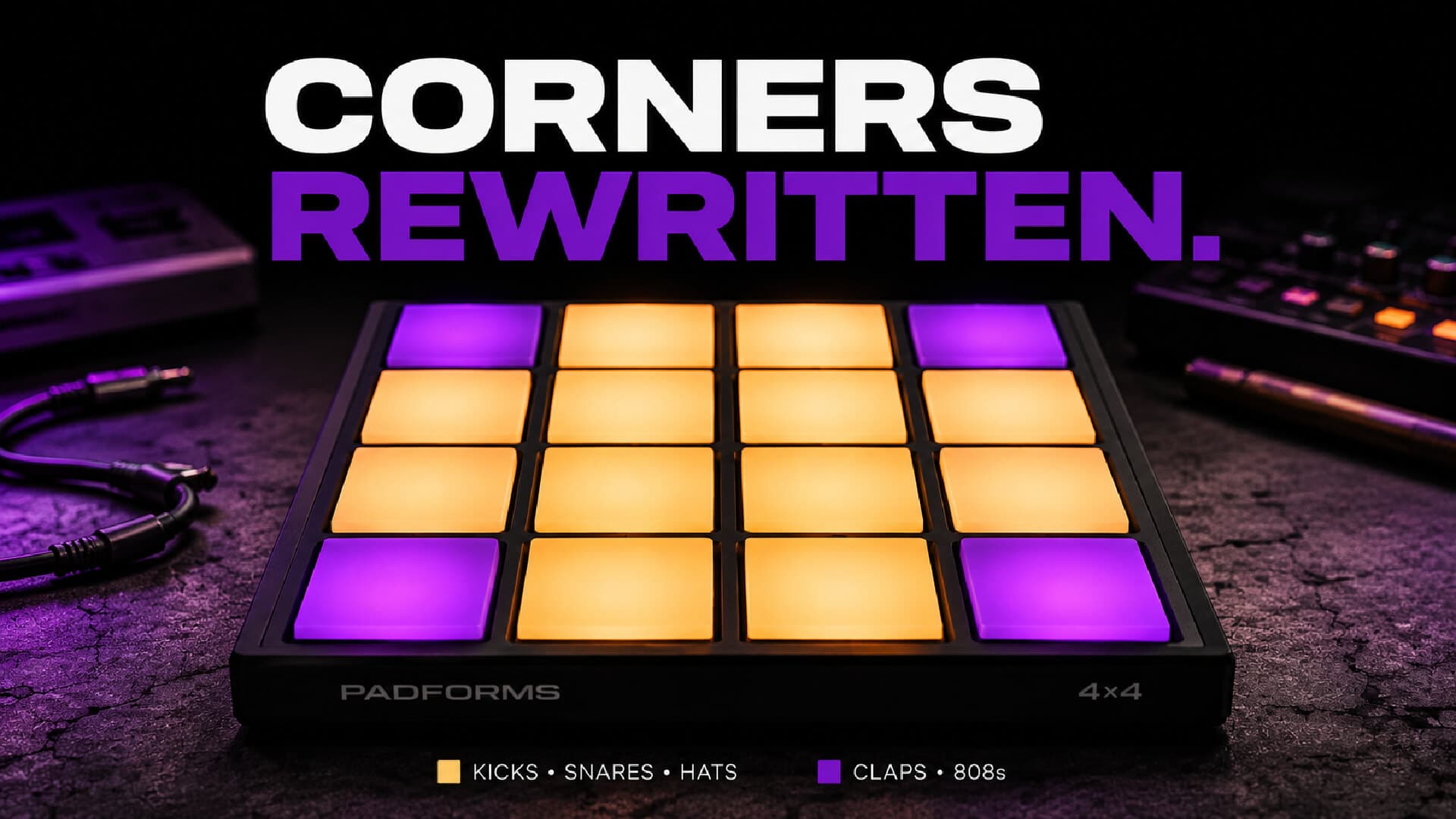
So we kept QFG's centered eight pads exactly as Mathijs has them, and rewrote only the corners.
What we picked
| Col 1 | Col 2 | Col 3 | Col 4 | |
|---|---|---|---|---|
| Row 4 | Tom (Mid) | Vocal Chop 1 | Vocal Chop 2 | Crash |
| Row 3 | Closed HH | Open HH | Closed HH | Ride |
| Row 2 | Clap | Snare | Snare | Clap / Rim |
| Row 1 | 808 / Sub | Kick | Kick | 808 / Sub |
Quest for Groove with the corners rewritten. Kicks and snares stay centered. The Closed-Open-Closed hat triplet stays. The corners (where QFG puts sidesticks and three cymbals) become claps and sub-bass. The top row keeps one tom for fills, adds two vocal-chop slots for performance moments, and a single crash.
Why, pad by pad
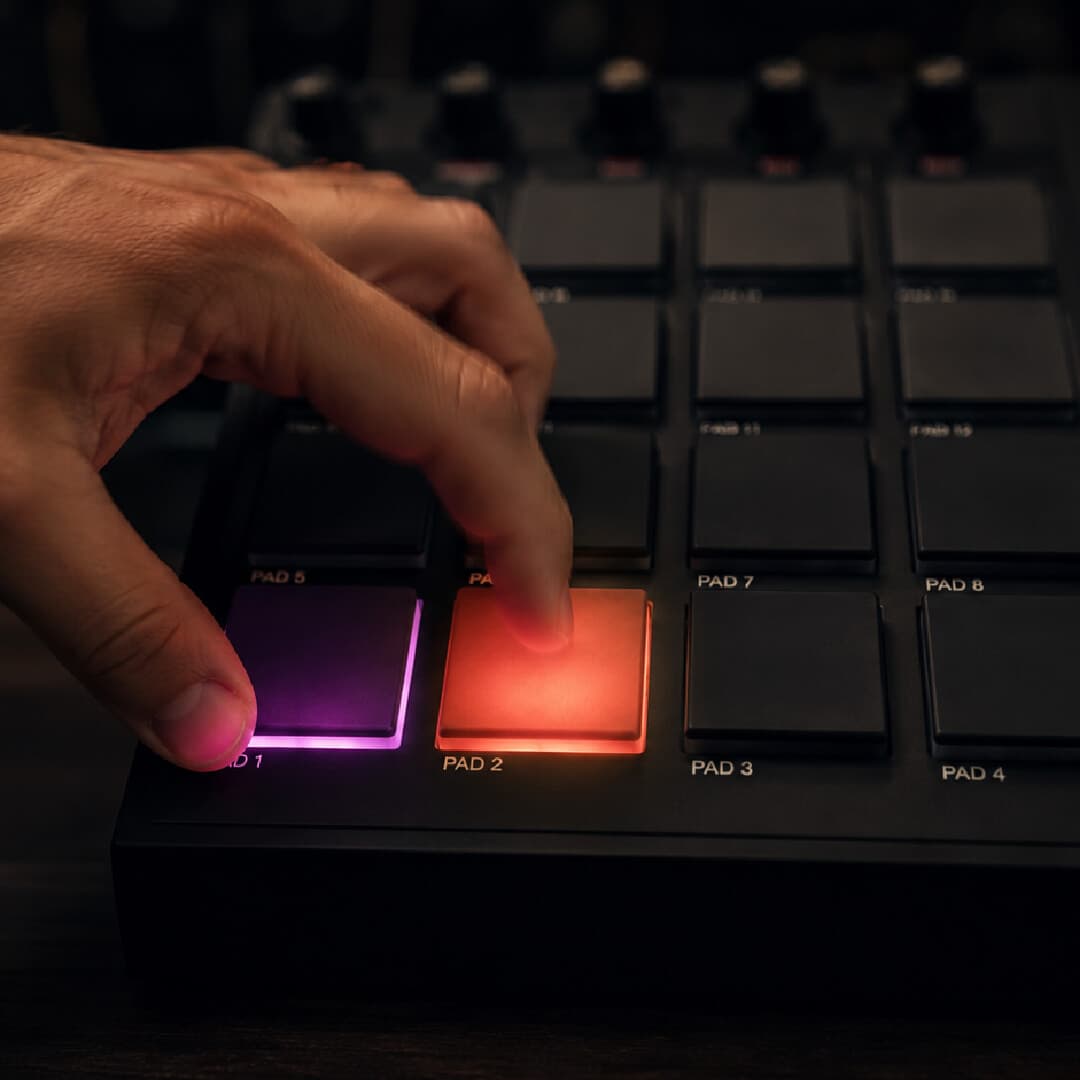
- Row 1 · kicks centered, sub-bass on the pinkies. The kicks are where Mathijs puts them; that's not a thing worth disagreeing with. The new bit is the pinky reach: one hand can strike thumb and pinky together and trigger a kick and a sub layer in the same motion. It's how kick-and-808 stacking is meant to feel, and you don't get it with a corner cymbal there instead.
- Row 2 · snares centered, claps on the corners. Clap is a backbeat sound modern production uses everywhere. Sidestick is a rock and jazz flavor. The row-2 corners fall under the index fingers when your hands are centered, which is too valuable a position for a sound we'll use once a song. This is Spacefood's idea, applied to QFG's geometry.
- Row 3 · hats centered, ride on the corner. Unchanged from Quest for Groove. Two closed hats either side of a mute-grouped open hat means you can run two-handed 16th-note alternation without thinking about which hand owns the hi-hat. This row is the one part of QFG I wouldn't change for anyone.
- Row 4 · one tom, two chop slots, one crash. Modern fills almost never need three tom flavors. Cutting back to one mid tom frees two pads up top for vocal chops, ad-libs, or transition FX: the things you actually reach for in a live set. The chop-on-top-row idea is the MPC-Tutor Vertical Kit's, scaled down. One crash is plenty for section endings.
What it means for the lessons
The lessons assume this layout so the visual cue stays consistent across the curriculum.
If you've already trained Quest for Groove, the centered core means day one feels familiar; only the corners are new.
If your controller doesn't fit the standard MIDI 36–51 map, head over to the contact page. Tell me what you're playing and I'll prioritise a tested profile.